
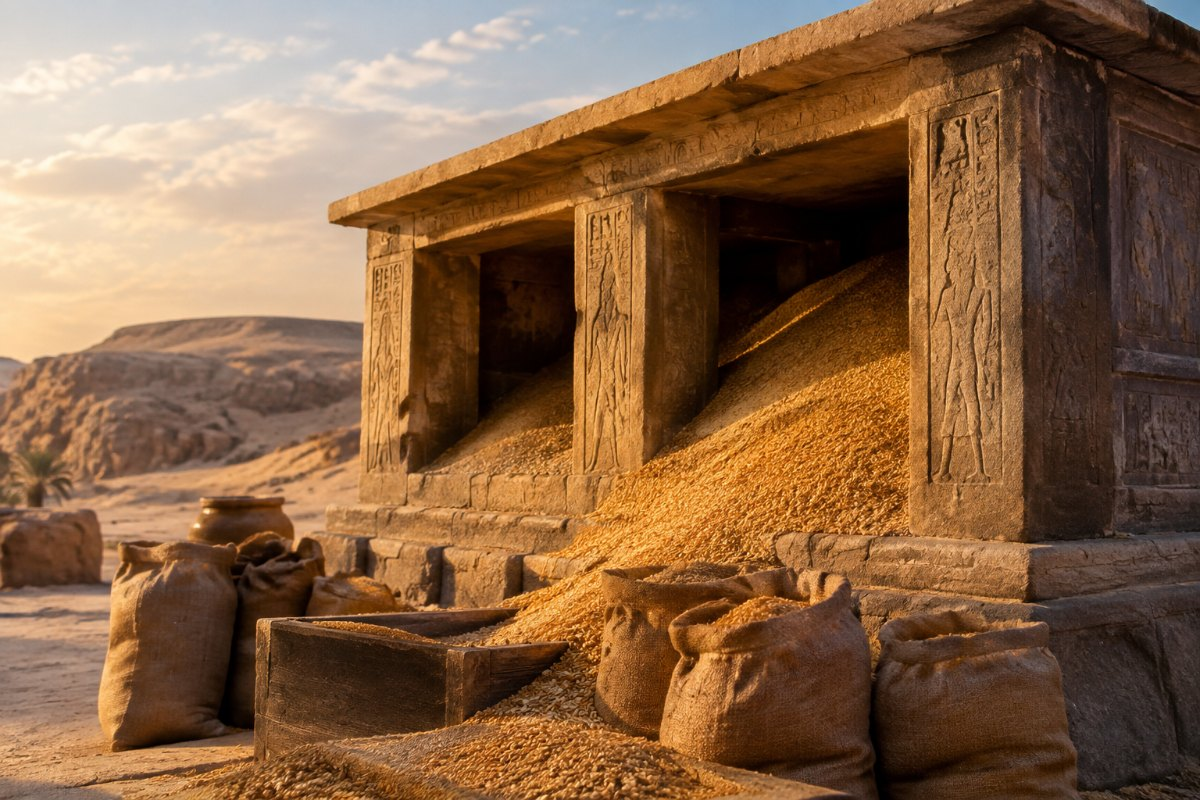
The story of Joseph is full of drama: a favored son sold by his brothers, a prisoner in a foreign land, and finally the second most powerful man in Egypt. Tucked inside that story is a surprisingly practical lesson about money. When Pharaoh was troubled by dreams of seven good years followed by seven years of famine, Joseph offered a plan.
The plan
“Let Pharaoh do this, and let him appoint officers over the land, and take up the fifth part of the land of Egypt in the seven plenteous years.” (Genesis 41:34, KJV)
Joseph recommended setting aside one-fifth of the harvest during the good years. The purpose was clear.
“And that food shall be for store to the land against the seven years of famine, which shall be in the land of Egypt; that the land perish not through the famine.” (Genesis 41:36, KJV)
Notice what Joseph did and did not do. He did not claim to predict the future on his own, since the warning had come through Pharaoh’s dreams. He did not tell people to hoard everything. He proposed a steady, measured portion, a fifth, set aside systematically during abundance so that the nation would survive scarcity.
Saving is for serving
The story does not end with a full warehouse. When the famine arrived, Joseph opened the storehouses and provided food, first to Egypt and then to people from surrounding lands, including his own family. The reserve existed not to make Egypt rich but to preserve life. That is a helpful reminder that saving is a tool. A reserve lets you take care of your family, help others, and avoid panic when conditions change.
What this means for your finances
Most of us will not face a seven-year famine, but life has its own seasons. Income can be steady one year and tight the next. A layoff, a health issue, or an economic downturn can arrive without much warning. Joseph’s plan suggests a simple habit: when times are good, save a meaningful portion, and do it before spending expands to match your income.
Good years are not guaranteed to repeat
Joseph’s strategy works because he treated the abundant years as temporary even while they felt permanent. That is an uncomfortable idea when business is booming, or a raise has just arrived. The temptation is to raise your lifestyle to match the new income, so that when income dips there is nothing left to cushion it. A practical response is to decide in advance how a windfall or a strong month will be divided: part to the emergency fund, part to a longer-term goal, part to generosity, and a modest part to enjoy. Deciding in advance matters because in the moment every purchase feels reasonable. For the starting point of building a reserve, see Lessons From the Ant: What Proverbs Teaches About Saving, and for turning plans into a monthly system, see Planning Ahead: What Proverbs Says About Budgeting.
Saving through feast and famine
Suppose your household takes home $5,000 per month. If you follow a version of Joseph’s one-fifth principle, you would set aside 20 percent. That is $1,000 each month and $12,000 across the full year (12 times $1,000). If that feels out of reach, begin with five or ten percent and increase it with each raise. The point is the pattern: a predetermined portion is saved first.
A good way to follow through is to automate it. A transfer to a savings account on payday means the money moves before you have a chance to spend it. It becomes part of your budget, not a leftover.
Irregular income and the good months
Joseph’s approach is especially helpful for people with uneven earnings, such as freelancers, commissioned workers, seasonal employees, and small business owners. If your income swings from month to month, treat your best months as Egypt’s seven good years. Decide on a baseline salary you pay yourself each month, and put anything above it into a reserve. When a slow month comes, you draw down the reserve and your household’s life stays steady.
Avoiding two misreadings
It is possible to misuse this story in two ways. One is to treat it as a command to accumulate as much as possible, which can drift into hoarding and fear. The Bible warns against storing up wealth for its own sake and forgetting God and neighbors. The other is to ignore it and spend everything because tomorrow will take care of itself. Scripture’s wisdom lies in between: save with purpose, hold what you save with open hands, and use it to serve.
A prayer for foresight
Lord, thank you for seasons of plenty. Give me the discipline to set something aside before it is spent, and the wisdom to use it well when hard times come. Keep my heart from fear and from greed. Amen.
Planning for the lean years
If you set aside one-fifth, or even one-tenth, of your next paycheck before spending anything else, what would that look like in practice, and what would you want that reserve to protect?
Where to go next: Lessons From the Ant: What Proverbs Teaches About Saving, Planning Ahead: What Proverbs Says About Budgeting, When Work Is Hard to Find: Faith and Provision in Lean Seasons, and Rest and Work: Why God Built Rhythm Into Provision.
Scripture quotations are from the King James Version (public domain). This article is for education and inspiration and is not personalized financial advice.