
If you are living paycheck to paycheck, or trying to climb out of debt, a sermon on generosity can leave you feeling more discouraged than inspired. What could you possibly give? Is a small gift even worth giving? The Gospel of Mark tells a short story that speaks directly to this feeling.
The story
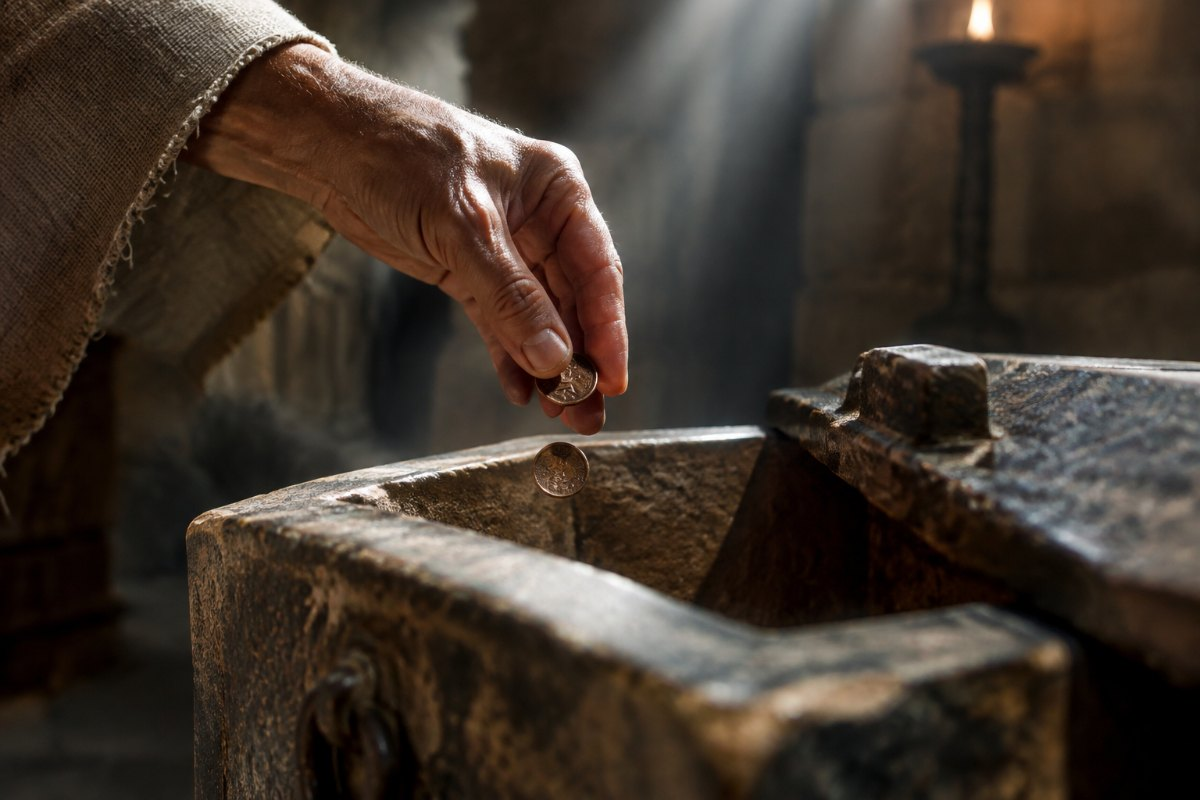
Jesus was sitting near the temple treasury, watching people drop in their offerings. Many wealthy people gave large amounts. Then a woman walked up.
“And there came a certain poor widow, and she threw in two mites, which make a farthing.” (Mark 12:42, KJV)
A mite was among the smallest coins in circulation. The amounts were tiny. Jesus noticed anyway, and called his disciples to look.
“Verily I say unto you, That this poor widow hath cast more in, than all they which have cast into the treasury: For all they did cast in of their abundance; but she of her want did cast in all that she had, even all her living.” (Mark 12:43-44, KJV)
What Jesus was saying
Jesus was not comparing the size of the gifts in dollars. He was comparing what each gift cost the giver and what it said about their trust. The wealthy gave out of their surplus, which was generous but did not touch their security. The widow gave from what little she had, and her offering was an act of faith.
It is worth reading the passage carefully. Jesus does not tell the woman to give. He does not hold her up as a rule that every poor person must give everything. He simply observes what happened and shows his disciples what real devotion looks like.
A caution for people with little
This story is sometimes used in ways that put heavy pressure on those who are struggling. It is important to balance it with another passage from Paul, who wrote about generosity in the churches of Macedonia.
“For if there be first a willing mind, it is accepted according to that a man hath, and not according to that he hath not.” (2 Corinthians 8:12, KJV)
The standard is what you have, not what you wish you had. God does not ask for what you do not possess. A family that cannot afford to give much is not failing. A willing heart, expressed in a manner that fits your actual circumstances, is what Scripture praises.
Ways to be generous with little
Giving is not limited to money. There are other things that are often scarcer than cash and just as valuable, such as time, attention, skills, encouragement, a meal, a ride, or childcare for a friend. Many people who are short on money are rich in these things.
Money can also be given in small amounts. A few dollars a week, given regularly and gladly, forms a habit and a spirit of generosity that can grow as circumstances improve.
Giving what is not money
Money is only one way to be generous, and for people on a tight budget it is rarely the most valuable one. A neighbor may need a ride, a meal, a morning of childcare, or someone to sit with them in a waiting room. Skills count too: a person who can fix a leaky tap, read a lease, or help with a résumé is carrying real wealth. Generosity of attention, like a phone call to someone who is lonely, costs almost nothing and is remembered for years. None of this replaces giving money when you can, but it keeps you from concluding that you have nothing to offer. If you are trying to bring a small but steady amount into your budget, How to Build Generosity Into Your Budget shows how.
Small gifts, real impact
Suppose a family has $20 left each week after bills and groceries. Giving ten percent of that margin would be $2 per week, which is $104 per year (52 weeks times $2). That may sound small, but over a year it could pay for several meals for a family in need or a gift to a ministry the family cares about. More importantly, the family is practicing generosity in a season of limits and learning that they can give without being rich.
If it feels like even that is too much while paying off urgent debts, they might choose to give their time instead: an hour a week helping at church, mowing a neighbor’s lawn, or sitting with someone who is lonely. The goal is the open hand, not a certain dollar amount.
What generosity does for us
There is a hidden benefit to giving when you have little. It loosens the grip of fear. Scarcity makes us anxious and inward-focused, and one of the quiet effects of giving is that it reminds us that we are not alone and that we are able to bless others even now.
A prayer from a thin wallet
Lord, you see what I have and what I lack. Thank you for caring about the heart behind a gift more than the size of it. Help me to be generous in the ways I can, free me from comparison, and teach me to trust you with what is left. Amen.
To think about this week: What is one small, concrete thing you could give this week, whether money, time, or help, that would be an act of trust and not of pressure?
More on the same theme: What the Bible Says About Giving: A Practical Guide to Generosity, How to Build Generosity Into Your Budget, When Work Is Hard to Find: Faith and Provision in Lean Seasons, and Contentment in Philippians 4: Learning to Be Content With What You Have.
Scripture quotations are from the King James Version (public domain). This article is for education and inspiration and is not personalized financial advice.